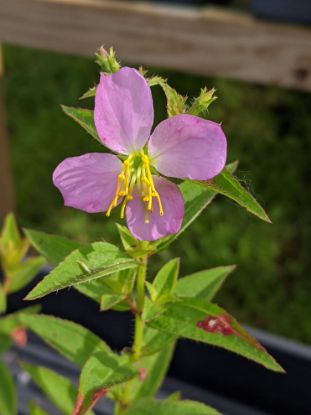
More common in Kansas. "Petals" could be red, or partially red, instead of yellow. Has a deep tap root, which it spends its first year growing so it may not flower until the second year. Best planted in masses or planted with other structural plants.
Love the green blades of Allium to provide color and texture to the garden and attract several small pollinators. Avoided by most mammals. Tolerates several sun/moisture conditions.
Amazing, large, yellow blooms open at night, so they're great for the moths. Dry, limestone rock areas are the natural home for these beauties, so they tolerate dry and hot conditions.
May spread aggressively through rhizomes and seed. Plant with other aggressive plants and divide in spring for a balanced planting. Taller plants may need to be supported. Doesn't like to dry out.
Fall dark-blue fruits are enjoyed by wildlife and people. Fruit production may be increased with multiple trees to cross pollinate. May perform a thicket unless suckers removed and plant pruned to desired shape. Prune right after flowering. Host for Spring Azure.
A beautiful compact shrub for a dry area. Attracts many pollinators and is browsed by the deer and rabbits. Flowers on new growth so trim after blooming, if desired.
Can be pruned a few times a year, and even hedged. Prolific reseeder. A study in KC showed that Symphyotrichum is one of the plant genera in our area that attracts the largest number of different bee species.
Spreads into a thicket - may be used as a hedge screen. Peeling bark adds winter interest. Flowers attract butterflies and moths. Fruits attract birds in the fall.